Crazy Cocktail Party Question For August...
Boy, is it ever hot and humid! It's hard to look fresh and composed in the August heat.
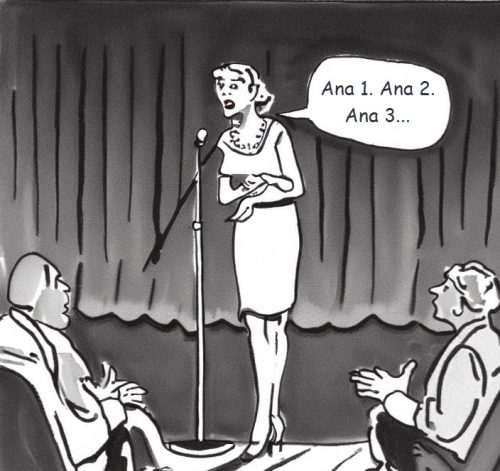
So when I whimsically asked a group of drooping American audience members,
"Would you rather look bad or smell bad?"...
I wasn't surprised by the 100% response.
Absolutely nobody wants to smell bad. Given a choice between the two, most people opt for looking bad over smelling bad. Here's the reasoning --
"Hey, if I look bad, only the people who look at me suffer my appearance. But when I smell bad -- everyone suffers."
Of course, this could be an entirely American opinion. We may seem obsessed with appearances, but we're hyper-vigilant about odors.
But really: what's worse -- looking bad or smelling bad? Take the poll, or leave a comment. ;)
Labels: Presentation
Bag Boring Brainstorming Meetings
Ah, the corporate brainstorming meeting fantasy. An enthusiastic moderator, a blank white board, a group of experts eager to share their ideas -- what could be better for generating a host of creative problem solving ideas?
Ah, the brainstorming reality. It turns out that solitude is a better approach to creative thinking. According to a
study team at Indiana University, groups come up with far fewer and much less creative problem-solving approaches. Individuals working alone have more ideas.
Instinctively, you already knew this. This is
old news. Brilliant creative artists seldom offer their best newly-formed ideas for group consideration or consensus. And you've witnessed the glazed looks of bored team members in the departmental brainstorm meeting.
Consider the rule: there's no such thing as a bad idea. You've heard, "yeah, that sounds good" voiced at the mention of the most mediocre idea. The ever-positive brainstorming moderator reminds us, "There's no criticism at a brainstorm meeting. The point is to get as many ideas on the board as possible. There's no such thing as a bad idea, so let your ideas flow!"
Of course, that's a fantasy, too. We've all heard loads of bad ideas at brainstorming meetings. I am often so intrigued by the mere idea of no bad ideas, that I make a point of voicing the worst ideas possible. When people start to look uncomfortable, I have to remind the moderator to write my lousy idea on the board.
Often, I am ignored. But at least I am highly internally amused -- before I get fired.
The plus side of brainstorming meetings. Of course, some will argue that brainstorming isn't all about creativity. Socialization and team-building is important, so the brainstorm session fosters that feel-good group interaction that people crave. But without an atmosphere of honest conversation and true accomplishment, the feel-goodness factor is a brainstorm fantasy, too.
A better approach to brainstorming. Instead of group brainstorm sessions, why not try virtual brainstorming? With virtual brainstorming, you can generate more creative ideas -- and still offer your team the socialization they crave. Here's how v-brainstorming works:
- Use email. The perky coordinator asks the brainstorm team to email him or her at least 10 ideas by a certain date. The rules: no offline collaboration with others. Team members are to come up with their own ideas, and email them by the (short) deadline.
- Create a presentation. The coordinator collates emailed responses. He or she creates a presentation to share at a brainstorm results meeting. Categories can include "Five Most Popular Suggestions", "Four Most Unusual", "Most Expensive", "Least Effort" -- you get the idea. The coordinator creates a number of categories that stimulate thought, conversation -- and maybe even a little fun.
- Share results. The coordinator leads the results meeting. Transformed from a chirping drone who mindlessly copies down sparse ideas, the moderator is now able to effectively lead an interesting conversation about the ideas the team generated independently.
Conversations shift from, "Yeah, that sounds good" to :
- "Wow! Ten of us had the same idea - but the most popular idea is the worst!"
- "Hmm. The 'least effort' idea is also the most expensive. That's a problem."
- "Customers will love the wackiest idea. The CEO will hate it. We should explore it further."
Better ideas. Group interaction. Conversation. Criticism. Analysis. Of course, a v-brainstorm meeting is more work for the coordinator -- but it's better for everyone else. Why not try one the next time you need ideas + interaction?
After all, the truth -- and creativity -- does not depend upon a consensus of opinion.
Labels: Presentation
Clichés, Buzzwords, and Jargon. Oh, my!

What's the difference between clichés, buzzwords, and jargon?
It doesn't matter. They're all related. They alienate your audiences. How?
Clichés bore. Buzzwords cloud the truth. And industry jargon confuses.
These three devils have become so omnipresent, all businesses need to hire outside copy editors to review their most important pieces of outbound communication. Seriously. Those who don't often inadvertently end up with what author David Meerman Scott calls "
Gobbledegook".
You might have a jargon problem...and not know it. Get a third pair of very critical "outsider" eyes to review your most important copy and presentations. And be prepared for brutal honesty! I'm often surprised that many companies don't know they're using jargon and clichés -- they think they sound "smart"!
Can't afford an editor? Try this eye-opening exercise. It may tip you off that your copy has a jargon, cliché, or buzzword problem:
- Take every instance of your company name in your suspect copy and replace it with your competitor's name. Ditto any product names. Replace 'em with a competitive product.
- Read the copy to your CEO, board of directors, key customers, PR, or marketing people. Ask if they think your competitors are ripping off your unique benefits or sense of style.
A big problem with using "smart" sounding industry jargon is that it sounds "dumb" to customers. Companies that use jargon miss an opportunity to distinguish themselves from their competition. And of course, they confuse or bore their audiences.
Do you have a buzzword problem? Find out for sure. Visit these four (fun) links to get some insight on how you can improve communication.
The Encyclopedia of Business Cliches - Seth Godin's Squidoo lens puts light-hearted focus on the growing problem of clichés in business speech. You can vote on the most grating, or add your own. (I had fun adding jargon I heard as I sat in on a teleconference. I added Industry Standard, net-net, Best Practices, Push the Envelope, and core competencies -- in less than 9 minutes!)
Netlingo.com - What are the kids talking about? IM shortcuts and acronyms are crawling into speech. So is tech-industry jargon. I used the Netlingo site to look up quasi-familiar tech-ish terms like ladder pass, Valley Washout, Mystery House, Flypaper Meeting, and Frendor. If you know what these terms mean, you must live in California. Or be 12.
Buzzword Bingo - This is one of my favorite game sites ever. Print randomly generated buzzword cards, pass them out to meeting attendees. When you mark five buzzwords in a row, you win!
Visual Clichés - It's not just words that get clichéd. We all get sick of seeing the same boring images that represent an abstract concept. Are you using visual clichés in your PowerPoint presentations, web copy, or company literature? What image can you live without seeing ever again?
Labels: Presentation
Regional Presentations: Check the Facts!
If you are presenting in an unfamiliar city, please do some regional fact-checking. It's easy to find some basic city info online: demographics, key industries, sports teams, colleges -- just a few basic factoids can really help you tailor your presentation and connect with your audience.
Plus, it can prevent you from opening your mouth and saying something regionally insensitive!
Here's the latest presentation horror story: Last week, I went to a Microsoft Conference -- a traveling road show here in beautiful Grand Rapids, Michigan. The MS presenter actually said (paraphrase),
"No one really needs office furniture. With the advent of wireless networking, no one needs a desk or a workspace. How many people here have worked from home or from a cafe on their wireless devices?"
Everybody raised their hands.
His next PowerPoint slide was a desk littered with post-it notes and coffee stains.
"The office desk is simply a useless space that accumulates clutter. It isn't a real productive place. Thank goodness you don't need to waste your money on expensive office furniture any more."
And then the presenter went blithely on with his MS Productivity software pitches. He seemed unaware that we were cringing uncomfortably in our ergonomic chairs.
The problem: Grand Rapids, Michigan is the home of the office furniture industry. Just about everybody in the audience has a stake in the success of the city's key industry. I don't think the guy made any friends denigrating the importance of office furniture in Grand Rapids, Michigan.
Microsoft would do well to have their employees fact-check cities before they go on the road!
But then again -- maybe MS programmers in Redmond, WA do their best work from backyard patios, noisy cafes -- and even tree houses. I wonder how a haphazardly organized approach to programming affects the quality of work.
In the interest of increasing productivity and shareholder value, do you suppose Microsoft will rid itself of desks in its cushy Redmond, Washington offices? And do they really encourage their best programmers to
go work in trees? ;)
Try doing creative and inspiring work in an uncomfortable, drab, gray office. Try maintaining a professional demeanor on a cell phone in a cafe while teenagers practice their swear words in the background. Try programming cohesively when you're swinging from a tree branch!
Good luck! Let me know how that works out for you!I know I am
way more productive and creative when I work in a beautiful, quiet, well-designed office space. You?Labels: Presentation
Embed YouTube into PowerPoint
How can you embed a YouTube video into your PowerPoint presentation? Basically, there are two ways to go about showing YouTube videos from PowerPoint:
1. The "Live" Way. If you are giving a PowerPoint presentation and you have a "live" internet connection, you can embed the YouTube video into your presentation directly from the internet.
2. The "Offline" Way. If you don't have a live (or reliable!) internet connection, you can download a YouTube video to your hard drive, convert it to MPEG, and insert the video into your presentation.
Let's tackle the "Live" Way first...
PowerPoint 2003 - Live! In this 4 minute, 13 second YouTube video titled "Embed YouTube into PowerPoint", charming 24-year-old reponzo01 shows you exactly how to insert a live video into a PowerPoint 2003 presentation. His clear instructions quickly guide you through everything you need to do.
PowerPoint 2007 - Live! If you have PowerPoint 2007, the instructions are only slightly different. In "Embed YouTube Video into PowerPoint 2007", I take 4 minutes and 45 seconds to show you what you need to do in 2007. (Warning: the sound quality is poor. I need a new mike...the 4th one I've blown through this year! Anyone have a suggestion for a QUALITY mike?)
Now, for the "Offline" Way...
PowerPoint 2003 - Offline! Once again, you can't go wrong with reponzo01's instructions, aptly titled Embed YouTube into PowerPoint Offline . This helpful young man takes about 9 minutes to carefully explain everything.
PowerPoint 2007 - Offline! But of course, inserting a video is a hair different in PowerPoint 2007. This 6 minute video titled, "Embed YouTube into PowerPoint 2007, no internet connection" shows you the mild differences.
Caveat: There's nothing fancy about these four videos -- they merely walk you through what you need to do as quickly as possible. The point of the videos is to show all the nuances that go between the
sparse written instructions on how to accomplish this increasingly popular task.
And of course, there's hope that all these inelegant instructions will become unnecessary in the very near future! As Ph.D. student Alice Marwick points out in her
feminism and technology blog, Google's long-awaited
PowerPoint killer may include YouTube video embedding as a standard.
But who knows? It might happen, it might not. And if it does, who knows when? Until then, you've got more than a couple of options to pursue. They may be a bit of a pain, but at least they get the job done!
Labels: content ideas, Presentation Applications
Taking the Twitter Challenge...

This month, I have made a commitment to testing Twitter. At my other blog, I am writing a series called "
Take the Twitter Challenge". Now, Twitter isn't new, and by now, it may have already
jumped the shark.
And I must admit that the
recent net buzz about Twitter leaves me befuddled. Why would anyone be interested in reading -- or writing -- sporadic, 140 character missives? And what's the point of making these missives public?
Because that's all Twitter does! You sign up for a free account. You answer one question: "
What are you doing right now?". You have to answer in 140 characters or less. Your response is instantly posted online. People decide (or not) to "follow" what you have to say. You decide who you want to "follow".
I'm not kidding. That's about all there is to it. And thousands of people, even
campaigning politicians and
celebrities, are twittering away. What about you?
As for me, I can't know it until I've tried it. Experience comes before knowledge. So for one month, August 2007, I will emerge myself in the Twitter culture. I will:
Explore the PR aspect- is Twitter a viable media channel for quickly and easily letting the public know what you're up to?
- Contemplate the metaphysical aspect - will focusing on "what are you doing right now?" put me in the moment and help raise consciousness?
- Consider the artistic aspects - can Twitter give rise to a new, Haiku-like art form of profound simplicity?
- Wonder about educational implications - will the 140 character limit help make me a better, more concise writer?
- Report on my successes and failures - You can follow along -- or take the Twitter challenge yourself.
Now -- am I overthinking Twitter entirely? Why don't I instinctively grasp the importance of Twitter, when just about everyone else seems to? Witness these quotes that I found in my Twitter Invite:
- "Twitter is on its way to becoming the next killer app." - TIME Magazine
- "It's one of the fastest-growing phenomena on the Internet." - New York Times
- "Suddenly, it seems as though all the world's a-twitter." - Newsweek
Is Twitter a quick, easy, cheap fix that will flash & fade? Or am I a hopeless dinosaur that just doesn't get the hub-bub?
I just started my
Twitter Journey, and I am amazed to find that I have four followers. I will continue my Journey, and keep interested parties updated in my "Twitter Challenge" series.
If you're an experienced
Twitterer and would like to share your insights or follow along with me, please do! I'd love to hear from you.
PS - my friend
Ursel points me to the above painting by
Paul Klee - the Twittering Machine. At the moment, this painting looks exactly how I feel. Does engaging in Twitter make one a twit?
Labels: Presentation